


 For finance
 For delivery


Overcome software project management challenges with ease
From scope creep to IT project delivery delays, there are a range of software project management challenges that can restrict growth. With the Microsoft Industry Cloud for Software Services Firms by sa.global, project delivery teams can boost efficiency and increase revenue by up to 36%.


Software project management challenges that impact profitability
Overwhelmed by constant project delays, unhappy clients, and a team struggling to keep up? You’re not alone. These are among the most common project management challenges faced by growing software services firms.
One of the biggest issues is the lack of integration between tools and a unified interface for information. This lack of integration increases software project risks and weakens software project risk assessment across the delivery lifecycle.
This disconnect quickly translates into recurring frustrations like:

Scrambling to meet deadlines
Different systems for different tasks make it hard to see the big picture, leading to missed opportunities and delays. These project management challenges often escalate software project risks.

Miscommunication and wasted time
Chasing down clarifications and addressing miscommunication eats away at valuable project time. This increases software project risk assessment complexity and delivery uncertainty.

Doing double
the work
Entering the same data into multiple systems or recreating work because of disintegrated systems feels tedious. This duplication is a classic example of project management challenges caused by fragmented tools.

Difficulty assigning the right people to projects
Without a clear view of who’s busy and what skills are needed, teams get overloaded, leading to burnout and missed deadlines. Poor visibility into capacity amplifies software project risks and delivery bottlenecks.

Struggling to keep up with change
Adapting to client needs and new technologies takes forever due to lack of agility in information sharing. These delays are among the most common software development problems in complex project environments.
Common software project management challenges derailing projects
The complexity of project lifecycles can lead to project delivery delays in software services, impacting profitability.
Effective alignment requires readily available information across the project lifecycle through integrated project delivery systems. Disconnected systems create silos, hindering collaboration and causing missed deadlines, budget overruns, and unmet user needs. Addressing these issues is crucial for software and technology companies to improve project success rates.
Successful projects result from connected sales and delivery teams, optimized resource use, minimal rework, improved productivity, streamlined billing, and enhanced collaboration. These outcomes are achieved when business functions align with project goals.
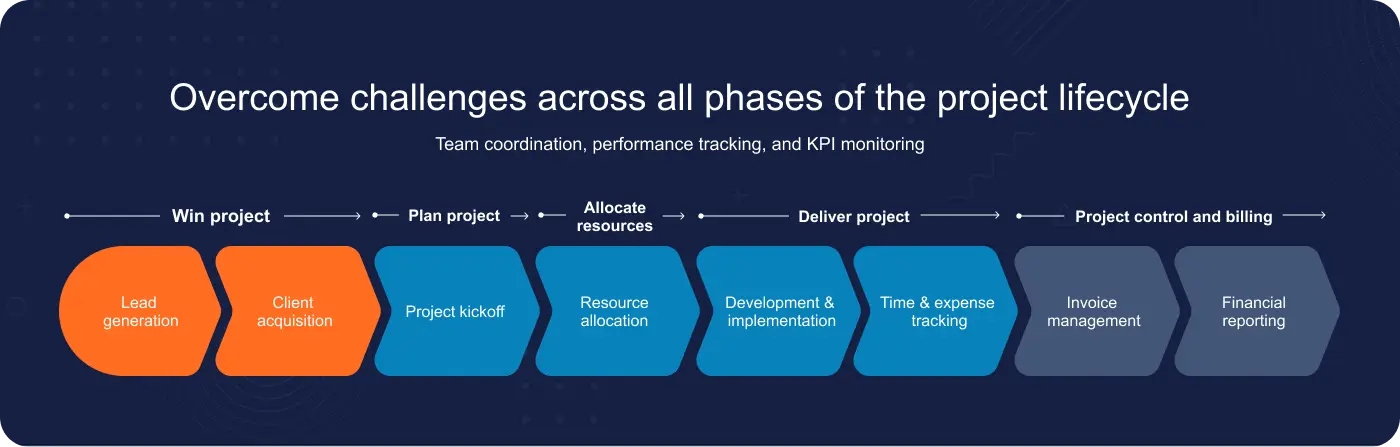
Disconnected teams, disrupted projects
Disconnected systems hamper collaboration and aggravate the challenges faced by finance, human resources, project delivery, and sales and marketing teams.

Complex, non-linear buyer journeys
The unpredictability of buyer behavior, with multiple decision-makers and diverse solutions, makes it difficult for software services firms to track customer readiness and tailor their approaches.
Disparate systems
Sales and marketing teams rely on multiple tools, causing data fragmentation. This lack of an integrated project delivery model leads to inconsistent decision-making and gaps in the client experience.
Inconsistent messaging
Lack of collaboration between sales and marketing creates disjointed messaging, disrupting the customer journey and impacting conversions.

Poor project visibility
Lack of visibility into the project pipeline and scope creep lead to poor planning, misalignment with business strategy, and added pressure on budgets and delivery timelines.
Lack of clear goals and responsibilities
Poorly defined goals and lack of accountability result in team conflicts and delays in IT project delivery.
Overburdening key resources
Overburdening key resources while underutilizing others leads to employee burnout, urgent hiring needs, and delayed ROI.

Poor cash flow visibility
Incomplete understanding of cash flow complicates responses to market fluctuations. Limited liquidity visibility and outdated information hinder effective decision-making.
Scattered data and inconsistent formats
Poor data quality and inconsistent formats across systems force finance teams to spend excessive time managing and analyzing data manually, increasing the risk of errors.
Iterative and manual processes
Time-consuming manual processes for financial closes, invoice generation, and project updates lead to inefficiencies.

Misaligned talent and project needs
Limited visibility into employee skills and project requirements leads to inefficient staffing, causing delays in IT project delivery and limiting client satisfaction.
Ineffective performance evaluation
Lack of comprehensive data across diverse projects hinders accurate 360-degree reviews, affecting productivity assessment and profitability analysis.
Inadequate employee development tracking
Resource management in IT project delivery isn’t just about allocation. It also includes monitoring individual career progression and learning needs in a fast-paced environment. Without this balance, employee engagement drops, and turnover rates rise.
The way forward?
Relying on separate point solutions for sales, HR, project delivery, and finance creates isolated systems of excellence.
However, this approach often leads to information silos that hinder collaboration, visibility, and growth. Integrated project delivery and management solutions that provide insights into other key functions serve as a game-changer but still don’t unify insights with other key business functions. It also prevents the effective use of AI to streamline operations, improve performance, and win more business. What is the way ahead then?


A connected, composable, intelligent cloud
What you need is a unified, connected platform that fosters collaboration, eliminates data silos, provides a holistic view of your projects, and is AI-ready.
At sa.global, we’ve harnessed the power of Microsoft Dynamics 365, Microsoft project management tools, and productivity apps along with Copilot, to build the Microsoft Industry Cloud for Software Services Firms that does just this for you.
FAQs
What are the most common causes of scope creep in software services?
Scope creep is one of the most common software project management challenges in software services firms. It typically occurs due to unclear requirements, frequent change requests, misaligned sales-to-delivery handoffs, and limited visibility into project scope. These common software development problems increase software project risks by introducing unplanned effort, cost overruns, and delivery delays.
How do disconnected systems impact project profitability?
Disconnected systems create data silos that make it difficult to track effort, costs, and progress in real time. This lack of integration is a major project management challenge, leading to inaccurate billing, missed revenue, and poor margin control. Without unified data, software project risk assessment becomes reactive, increasing the likelihood of budget overruns and reduced profitability.
Why is real-time resource visibility critical for software project managers?
Real-time resource visibility allows project managers to understand availability, workload, and skill alignment across teams. Without it, firms face software project management challenges such as over-allocation, burnout, and underutilization. Poor visibility increases software project risks by delaying decisions and reducing the ability to respond to delivery issues proactively.
How can tech firms reduce non-billable hours through better project tracking?
Tech firms can reduce non-billable hours by using integrated project tracking that links time capture, task progress, and delivery milestones. This approach addresses project management challenges caused by manual tracking and disconnected tools. Better tracking improves accountability, strengthens software project risk assessment, and minimizes revenue leakage caused by unbilled or misallocated work.
What role does a unified data model play in preventing project delays?
A unified data model ensures all teams work from the same real-time information across sales, delivery, finance, and resourcing. This eliminates reconciliation delays and reduces common software development problems such as conflicting timelines and outdated forecasts. By improving visibility, a unified data model helps mitigate software project risks and prevent delivery delays.
How does the Microsoft Industry Cloud for Software Services Firms integrate sales and project delivery?
The Microsoft Industry Cloud for Software Services Firms connects sales pipelines directly with project delivery data, including scope, capacity, and financial constraints. This integration reduces software project management challenges caused by misaligned expectations and late handoffs. By unifying data across functions, it strengthens software project risk assessment and improves delivery predictability.
What are the signs of a software project heading over budget?
Early signs include frequent scope changes, rising non-billable hours, delayed milestones, inconsistent time tracking, and poor visibility into actuals versus forecasts. These indicators reflect underlying project management challenges and unmanaged software project risks. Identifying these signs early allows teams to intervene before budget overruns impact profitability.